
Apple has discreetly been laying the groundwork for an AI (artificial intelligence) revolution for several years. In 2026, that vision became fully apparent when Apple showcased their comprehensive range of intelligent Mac, iPhone, and iPad models with the concept of Apple Intelligence 2026. Rather than utilizing remote data centers for artificial intelligence operations, Apple is committing to an alternative paradigm called ‘localized artificial intelligence’. This signifies that the computational smarts reside inherently within the gadget you hold or position on your desk.
This transformation is very insightful as it reshapes user engagement with the latest technology. Embedded AI on a gadget provides enhanced speed, increased confidentiality, and generally superior dependability. The latest introductions in Apple’s hardware portfolio—from the economical MacBook Neo to the high-performance MacBook Pro equipped with the M5 Max—embody an approach nicely crafted upon this principle.
The Expansive Scope of Apple’s AI Initiative
The company isn’t merely integrating isolated machine learning functionalities irregularly. Instead, it’s constructing a holistic environment of hardware optimized for AI, covering portable computers, slates, mobile phones, and specialized computational setups. This integrated environment derives its capabilities from Apple’s most recent silicon processors, such as the M5, M5 Pro, and M5 Max, which deliver substantial enhancements to:
Visual content creation
Processing of machine learning algorithms
Intensive design projects
For typical consumers, this translates to more fluid image manipulation, more intelligent digital companions, and superior tools for efficiency. For specialists—software engineers, film editors, and graphic artists—it represents the capacity to execute complicated AI frameworks directly on their personal systems, bypassing the necessity for extensive cloud computing resources. That saves a lot of bucks, isn’t it?
Apple’s Fundamental Shift Towards Integrated AI (Apple Intelligence 2026)
The predominant characteristic evident throughout Apple’s refreshed product range is embedded artificial intelligence. Apple suggested that the progression of AI will unfold natively on individual gadgets for three primary reasons:
Data Confidentiality: When AI tasks run locally, private information—including communications and images—is kept safe.
Immediate Operational Speed: Integrated AI eliminates the latency inherent in cloud networks. Operations such as vocal interpretation or photographic refinement are executed with near-instantaneous speed.
Reduced Reliability on Connectivity: Many smart functionalities remain operational even in the absence of an internet connection. Who needs an internet now!
Apple’s Advanced AI Hardware Ecosystem – Macintosh Computers Optimized for AI Operations
The most substantial enhancements are manifest within the Mac series. Recent systems featuring M5 Pro and M5 Max processors provide immense processing capabilities for machine learning. These components encompass expansive CPU and GPU arrays, complemented by robust neural processing units optimized for AI reasoning and learning phases.
Intelligent iPhones
Apple also showcased refreshed mobile phones, exemplified by the iPhone 17e, which incorporates the best imaging sensors and expanded data retention capacities. These gadgets weave AI functionalities seamlessly into common activities like capturing images and engaging via voice.
Enhanced iPads for Creative and Productive Work
The iPad collection, including revised iPad Air units, delivers ample processing might for imaginative undertakings like digital artistry, cinematic montage, and audio composition, bringing slate computing closer to the sophistication of a comprehensive AI workstation.
The Contemporary M5 Chip Architecture
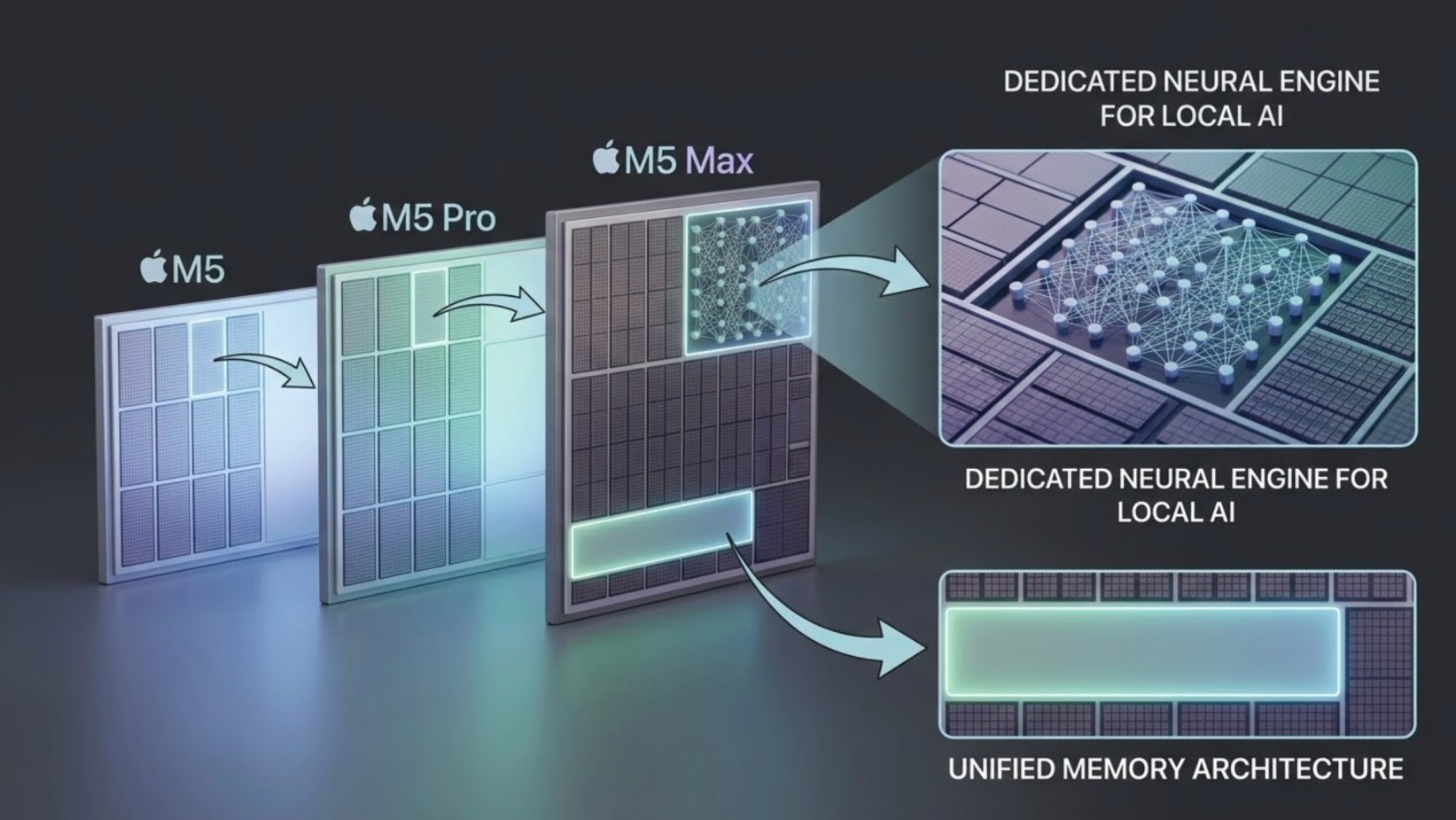
The M5 processor series signifies a major progression in computational design through its Fusion Structure. This framework integrates two 3-nanometer semiconductor modules into a singular system-on-a-chip, leading to a great augmentation in data throughput.
CPU, GPU, and Neural Engine Enhancements
These silicon components feature an 18-core CPU (six “power cores” and twelve economical cores). The enhancements in AI operational capability are particularly striking:
| Capability | Enhancement in Speed |
| Creation of AI-generated visuals | Up to 7.8× faster vs M1 Pro |
| Processing of Large Language Model prompts | Up to 6.9× faster vs M1 Pro |
| Tasks involving three-dimensional rendering | Up to 5.2× faster vs M1 Pro |
The New Laptop Lineup – MacBook Pro (M5 Pro and M5 Max)
Engineered for professionals, these models (14-inch and 16-inch) can train bespoke models locally and process vast datasets.
M5 Pro: Starts with 1TB internal storage.
M5 Max: Starts with 2TB internal storage.
Connectivity: Features Thunderbolt 5 and ultra-swift SSD speeds.
MacBook Air (M5)
Striking a balance between portability and efficiency, the M5 chip allows this laptop to execute AI tasks up to four times quicker than the preceding M4 model and nearly ten times faster than older M1 devices.
MacBook Neo: Accessible AI

With an introductory price point around $599 (~55k INR), the MacBook Neo serves as an affordable gateway. It supports AI features via a robust A-series chip, extending intelligent computing to a broader audience.
Benchmark Performance: Are Apple’s Macs Already “AI PCs”?
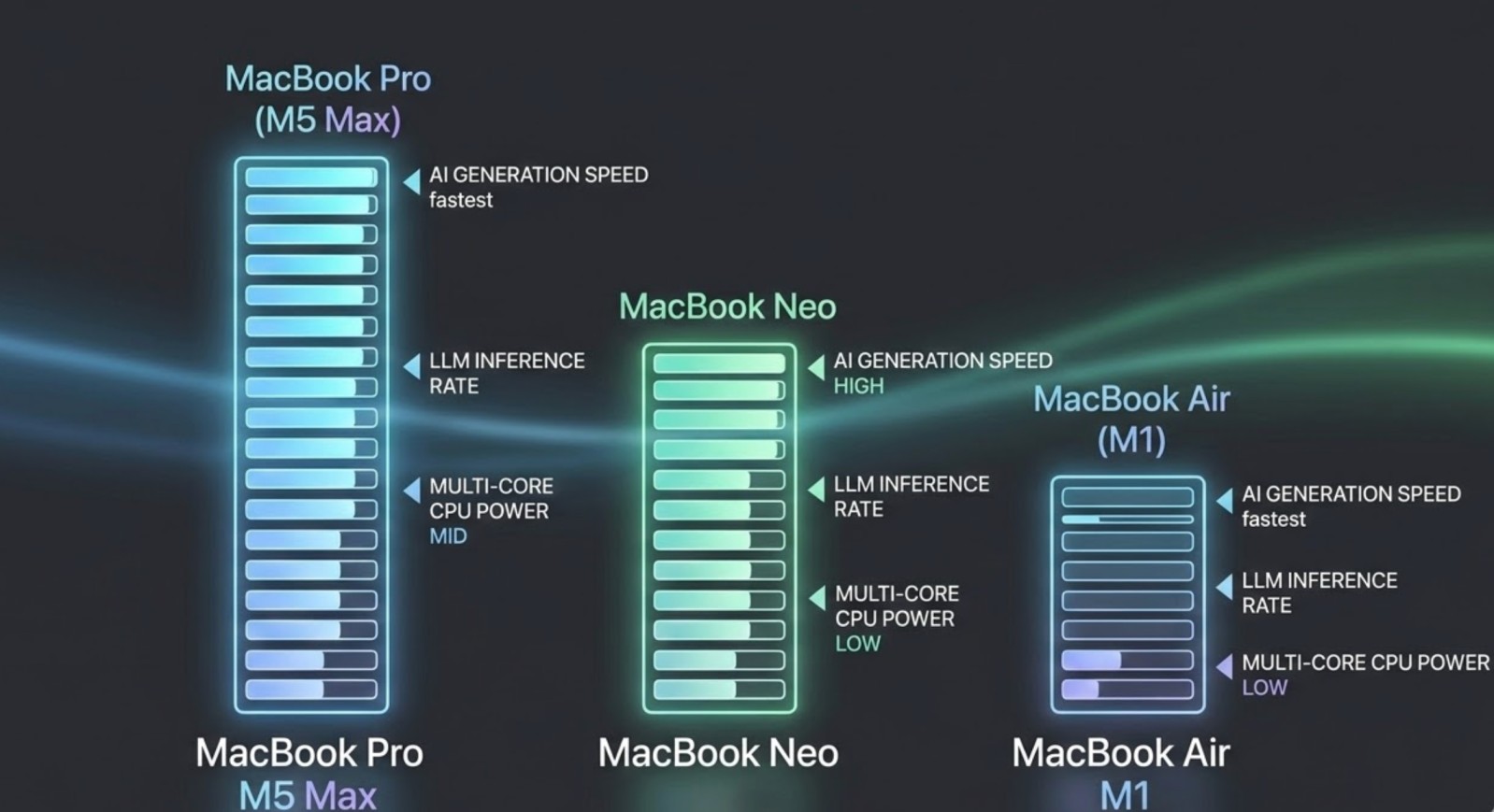
Preliminary leaks indicate a significant advantage over competitors:
| Device | Single-Core Score | Multi-Core Score |
| MacBook Pro M5 Max | 4,268 | 29,233 |
| MacBook Neo | 3,461 | 8,668 |
| MacBook Air M1 | 2,346 | 8,342 |
How Apple’s AI Approach Differs From Its Rivals
While Microsoft, Google, and OpenAI rely extensively on cloud infrastructure, Apple emphasizes edge computing. This strategy offers:
Enhanced data confidentiality.
Diminished response times.
Increased command over personal information.
By engineering both the software and the proprietary chips, Apple optimizes every component for AI-centric workloads.
Why This Matters for the Future of Computing
If successful, Apple’s strategy will transform AI from a separate utility accessed via portals into an organic extension of the computing interaction. Laptops will render graphics instantly, smartphones will categorize photo collections automatically, and tablets will turn sketches into polished illustrations—all natively.
Conclusion
Apple’s newest range of devices represents an ambitious technological shift. By redefining the capabilities of personal computing through the M5 chip family and devices like the MacBook Neo, Apple is ensuring the most potent AI instrument you employ isn’t in a distant cloud—it’s right on your desk.
If you love AI, then you might also like: Top weird facts about AI
FAQ
1. What defines Apple’s strategy for on-device artificial intelligence?
Apple’s methodology for integrating AI directly into devices prioritizes executing artificial intelligence operations right on its own equipment, such as Macs, iPhones, and iPads, rather than depending extensively on remote cloud infrastructures. This approach enhances operational velocity, data confidentiality, and system dependability.
2. Can you tell me about the M5 chip?
The M5 chip represents the newest iteration within Apple’s series of custom-designed Apple Silicon processors. It incorporates enhanced central processing unit (CPU), graphics processing unit (GPU), and neural engine functionalities, all engineered to expedite artificial intelligence processing tasks.
3. What kind of product is the MacBook Neo?
The MacBook Neo is an innovative and budget-friendly portable computer from Apple, crafted specifically for academic use by students and general computing by daily users. With its affordable cost, it continues to offer support for advanced AI functionalities and contemporary Apple technological innovations.
4. What is the speed enhancement of the latest MacBook Pro when handling AI operations?
Apple claims that the refreshed MacBook Pro, equipped with M5 series chips, is capable of achieving as much as 7.8 times quicker artificial intelligence-driven image creation in contrast to the prior M1 generation models.
5. What is the rationale behind Apple’s prioritization of local AI over cloud-based artificial intelligence?
Implementing AI directly on devices offers quicker operational responses, enhanced user data confidentiality, and diminished dependency on continuous internet access, thereby rendering it a more practical solution for typical daily computational needs.
6. Is there an Apple M5 chip?
Yes, Apple launched the M5 chip in late 2025, followed by the M5 Pro and M5 Max in March 2026.
7. Is Apple launching the M5?
Apple has already launched the M5 series, with the latest M5 Pro and M5 Max models announced on March 3, 2026.
8. Is M5 or M4 Pro better?
The M4 Pro offers more CPU/GPU cores for heavy multitasking, but the M5 features new Neural Accelerators that make it superior for AI-specific tasks.
9. What’s faster, a M5 or M4?
The M5 is approximately 15% faster in CPU tasks and up to 4x faster in AI processing compared to the M4.
10. Is Apple making an M5 chip?
Apple has completed the design and production of the M5 family, which is now powering the 2026 MacBook Air and Pro lineups.
11. When did the M5 chip come out or When did the M5 MacBook Air come out?
The base M5 chip debuted in October 2025, while the high-end M5 Pro and M5 Max were released on March 3, 2026. And the M5 MacBook Air was announced on March 3, 2026, with official store availability starting March 11, 2026.